At ARITH 2026, I was happy to co-run the tutorial Optimizing Datapath Circuits with MLIR and CIRCT with Sam Coward. The tutorial was part of the ARITH tutorial day, on Saturday June 27, 2026, and focused on a question I care about a lot: how compiler infrastructure can make hardware design more inspectable, transformable, and testable.
The hands-on material is available here: cowardsa/CIRCT_TUTORIAL_2026. The tutorial slides are also in the repository: CIRCT_DEMO_2026_SLIDES.pdf.

The first slide already tells the story: Sam, me, and a tutorial built around making CIRCT concrete.
The Tutorial
The ARITH tutorial page described the session as a brief overview of how compiler technologies can offer another route into EDA. In practice, that meant starting from small circuits and moving through concrete compiler operations rather than staying at the slogan level.
The material walked through:
- parsing Verilog into CIRCT IR,
- applying passes such as range narrowing and canonicalization,
- checking transformations with
circt-lec, - emitting Verilog with
firtool, - moving toward datapath synthesis and AIGER output.
I liked this format because it made CIRCT feel less like a large infrastructure project and more like something participants could actually touch. You could edit a circuit, run a pass, ask whether the result was equivalent, and see where the hardware representation changed.
The Demo
During the ARITH demo session on Monday June 29, 2026, I also showed Printing Mathematical Intent onto Silicon with Emeraude-MLIR, HAriCo, and OpenROAD, listed in the ARITH program.
The pitch was deliberately direct: I want to keep mathematical intent visible long enough that it can influence the silicon we eventually generate. The demo connected three parts of my current stack:
- Emeraude-MLIR to carry tensor, DSP, and arithmetic structure through progressive lowering,
- HAriCo to materialize arithmetic circuits in a compiler-friendly way,
- OpenROAD to make the result land in physical design rather than stop at abstract RTL.
Yes, I like catchy titles. This one was my way of saying that compiler IR should leave a visible trace all the way down to layout.
One of the examples starts from Python tensor code shaped like an LLM feed-forward sublayer. Another starts from a Faust audio DSP expression. They are intentionally different front ends, but they share the same constraint: useful arithmetic structure should not disappear before the compiler has a chance to act on it.
For the visual part, I showed an OpenROAD placement animation from a generated systolic-array layout. The video is here:
The showoff part: a 6x7 FloPoCo systolic-array placement run turned into a small OpenROAD animation.
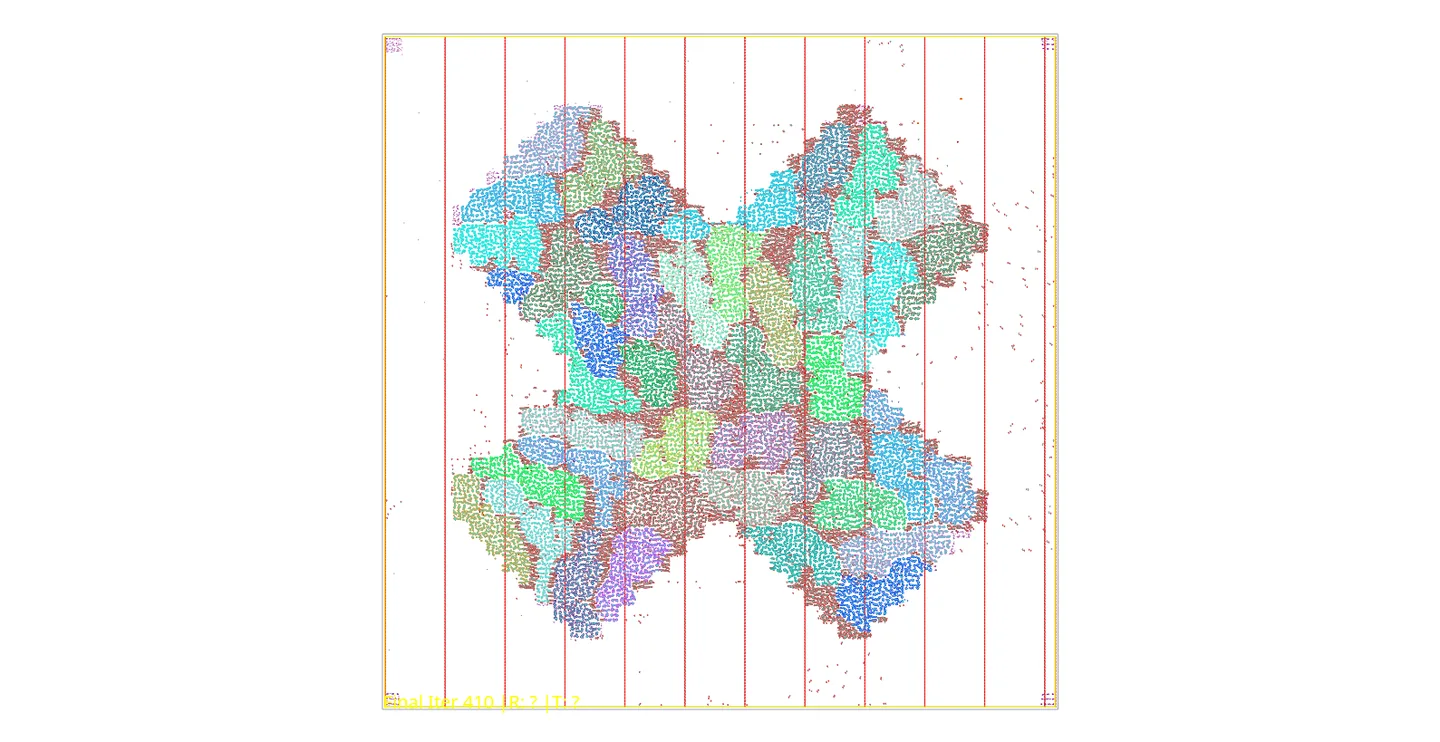
One frame from the animation; I like when a layout is still technical evidence, but also something you want to look at.
Why I Liked Animating This
The most useful conversations around this work usually happen when the abstraction layers are visible at the same time. A tutorial makes the compiler machinery approachable. A demo makes the physical consequences tangible. ARITH was a good place to bring those two modes together: formal enough to discuss correctness and arithmetic, but close enough to the tools that people could ask practical questions about passes, verification, and layout.
That balance is exactly where I want this line of work to keep moving.
Useful links: